Frequently Asked Questions
The most-asked questions about prefectures of japan.
What exactly is a prefecture in Japan?
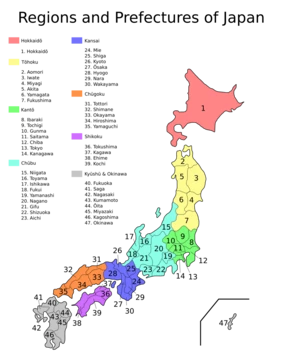
A prefecture is Japan's primary first-level administrative division, functioning similarly to a state or province elsewhere. There are 47 in total, each with its own local government, capital city, and distinct regional identity.
How many prefectures make up Japan?
Japan is divided into 47 prefectures: 43 standard 'ken,' one metropolis (Tokyo), one capital (Kyoto), and one bureau (Hokkaido).
What are the eight regions of Japan?
The prefectures are loosely grouped into Hokkaido, Tohoku, Kanto, Chubu, Kansai (Kinki), Chugoku, Shikoku, and Kyushu-Okinawa. These are cultural and geographic clusters rather than formal political units.
Which prefecture is the most populous?
Tokyo, the national capital, is by far the most populous, housing roughly 14 million residents across its 23 special wards and surrounding islands.
What is the smallest prefecture by area?
Tokyo is the smallest at roughly 2,194 square kilometers, while Hokkaido in the far north is the largest at over 83,000 square kilometers.
How is a prefecture governed day to day?
Each prefecture is led by an elected governor and a single-chamber prefectural assembly that drafts local ordinances and budgets. They manage education, public health, and infrastructure within the framework set by national law.
When were the current 47 prefectures established?
The modern system was largely finalized during the Meiji Restoration in the late 1860s and 1870s, replacing the old feudal han domains. Okinawa Prefecture was the last to join the set in 1972 after the end of U.S. administration.
What's the difference between the suffixes ken, to, do, and fu?
'Ken' (prefecture) is the most common suffix, 'to' (metropolis) is used only for Tokyo, 'do' (capital) for Kyoto, and 'fu' (metropolis) for Osaka and Fukuoka. In practice all four function identically as first-level administrative divisions.
Which prefecture has the smallest population?
Shimane Prefecture in the Chugoku region has the fewest residents, at roughly 660,000 people.
Where should a newcomer start learning about Japanese prefectures?
A good entry point is to explore the eight regional groupings first, then dive into individual prefectures by their capitals, major industries, and cultural landmarks. Starting with the Kanto region around Tokyo gives useful context before branching out to less familiar areas.