Saga Prefecture
A Kyushu prefecture known for ceramics and historical significance.
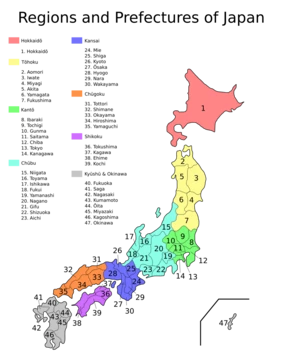
Saga Prefecture (佐賀県, Saga-ken) is a prefecture of Japan located on the island of Kyushu. It has a population of roughly 780,000 and a geographic area of 2,439 square kilometres. Saga is the capital and largest city, with other major cities including Karatsu, Tosu, and Imari. The prefecture occupies the northwest of Kyushu, forming an isthmus-like region that stretches between the Sea of Japan and the Ariake Sea. It borders Fukuoka Prefecture to the northeast and Nagasaki Prefecture to the southwest.
Historically, the area now comprising Saga and Nagasaki Prefectures was known as Hizen Province, with the current name dating from the Meiji Restoration. Rice farming has been a cornerstone of the region since ancient times, as evidenced by archaeological sites such as the Nabatake ruins in Karatsu and the extensive Yoshinogari site in Yoshinogari. During the feudal period, from the Kamakura to Muromachi eras, over 100 feudal clans are thought to have existed, alongside the influential Matsuratō samurai clan operating along the Genkai Sea. In the Sengoku period, the Ryūzōji clan expanded its control across Hizen, Chikugo, and parts of Higo and Chikuzen Provinces. Following the death of daimyō Ryūzōji Takanobu, Nabeshima Naoshige seized control, and by 1607 all Ryūzōji domains were under the Nabeshima clan. In the Edo period, this area became the Saga Domain, which included the sub-domains of Hasunoike, Ogi, and Kashima, as well as the Karatsu Domain and territories of the Tsushima-Fuchū Domain. The Nabeshima clan and its lineages maintained relative political stability, though the domain faced financial strain from defending Nagasaki, the Kyōhō famine, and the devastating Siebold typhoon of 1828. Reclamation of land from the Ariake Sea significantly increased arable land, and by the 1840s the domain’s annual koku had doubled to about 670,000. In the mid-19th century, Naomasa Nabeshima reformed finances, reduced officials, and promoted local industries such as Arita porcelain, green tea, and coal. Proximity to the international port of Nagasaki facilitated the introduction of foreign technologies, including reverberatory furnaces and steam locomotive models. After the Boshin War, many from Saga Domain contributed to the Meiji Restoration, and in the Meiji era, coal mines in Kishima and Higashimatsuura districts were modernized with the help of new railroads. The
- Capital
- Saga
- Population
- ~780,000
- Area
- 2,439 km²
- Known for
- Ceramics and porcelain (Karatsu, Imari, Arita); historical Saga Domain
Lore & Background
In ancient times, the area of Saga and Nagasaki Prefectures was called Hizen Province. Rice farming culture prospered since ancient times, with vestiges at the Nabatake ruins in Karatsu and the Yoshinogari site. From the Kamakura period to the Muromachi period, over 100 feudal clans existed, and the Matsuratō samurai clan operated along the Genkai Sea. During the Sengoku period, the Ryūzōji clan expanded control over Hizen, Chikugo, and parts of Higo and Chikuzen Provinces. After the death of daimyō Ryūzōji Takanobu, Nabeshima Naoshige took control, and by 1607 all Ryūzōji domain was under the Nabeshima clan. In the Edo period, the area was called Saga Domain, with sub-domains Hasunoike, Ogi, and Kashima, plus Karatsu Domain and territories of Tsushima-Fuchū Domain. The domain was relatively stable, though financial strain came from defending Nagasaki, the Kyōhō famine, and the 1828 Siebold Typhoon. Reclaimed land from the Ariake Sea increased arable land, and by the 1840s annual koku reached about 670,000. Around the mid-19th century, Naomasa Nabeshima reformed finances, reduced officials, and encouraged local industry such as Arita porcelain, green tea, and coal. Proximity to Nagasaki brought new technologies like the reverberatory furnace and steam locomotive models. After the Boshin War, many from Saga Domain assisted the Meiji Restoration. In the Meiji era, coal mines in Kishima and Higashimatsuura districts modernized with railroad construction.
Reader's Guide
Saga Prefecture's significance lies in its long history as a center of rice cultivation, ceramics, and feudal governance. The Yoshinogari site and Nabatake ruins provide archaeological evidence of early Yayoi and Jōmon period settlements. The prefecture's feudal period saw the rise and consolidation of the Ryūzōji and Nabeshima clans, with Saga Domain becoming a major political entity. The domain's financial recovery and adoption of Western technology in the 19th century contributed to Japan's modernization. Saga's legacy includes its role in the Meiji Restoration and its continued production of ceramics, particularly Arita porcelain. The prefecture's geography, with plains, mountains, and coastal areas, supports agriculture and forestry, while its natural parks and historical sites attract visitors. The re-establishment of Saga Prefecture in 1883 after a period of mergers underscores its administrative resilience. Today, Saga is a largely rural prefecture with a mild climate, known for its cultural heritage and as a gateway for cultural transmission from mainland Asia.
Did You Know?
- Saga Prefecture's western region is known for the production of ceramics and porcelain, particularly in the towns of Karatsu, Imari, and Arita.
- The Yoshinogari site in Yoshinogari dates back to the 1st century BC, the middle of the Yayoi period.
- By the 1840s, the annual koku of Saga Domain increased to about 670,000, twice that of 200 years before.
- The Siebold Typhoon of 1828 caused heavy damage in Saga, with deaths estimated at over 10,000.
- Saga Prefecture was re-established as an independent prefecture, separated from Nagasaki Prefecture, in 1883.
Frequently Asked Questions
Who is Saga Prefecture?
Saga is a compact prefecture on Kyushu island, governed from its capital city of Saga and home to roughly 780,000 people across 2,439 square kilometres.
What are Saga Prefecture's signature abilities?
Its most celebrated craft is ceramics and porcelain, with the towns of Karatsu, Imari, and Arita each contributing a distinct style to Japan's pottery tradition.
How does Saga Prefecture's origin story go?
The region's history stretches back through ancient rice-farming communities and the feudal Saga Domain, eventually playing a part in the upheavals that led to the Meiji Restoration.
Why is Saga Prefecture considered important in the wider Kyushu 'universe'?
Beyond its world-renowned porcelain, Saga carries a long thread of political and cultural influence that links pre-modern Japanese society to the modern era.
Where exactly does Saga Prefecture sit on the map?
It occupies a small stretch of Kyushu's northwestern coast, making it one of the island's more geographically modest prefectures.
More in Prefectures Of Japan 1-24
Related in Prefectures Of Japan
Links follow this subject's own source article.
Spotted an error? Know more?
This is a living reference — every entry is fact-audited, and reader corrections feed straight into our audit queue. Suggest an edit · See this site's audit record