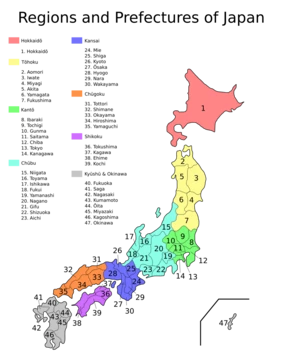
Chiba Prefecture
A Japanese prefecture on the eastern Pacific coast, part of Greater Tokyo.

Ineshima · CC BY-SA 4.0
Chiba Prefecture (千葉県, Chiba-ken) is a prefecture of Japan located in the Kantō region of Honshu. It is part of the Greater Tokyo Area, the most populous metropolitan area in the world, and is home to Narita International Airport, the Tokyo Disney Resort, and the Keiyō Industrial Zone. The prefecture largely consists of the Bōsō Peninsula, which encloses the eastern side of Tokyo Bay.
- capital
- Chiba
- region
- Kantō, Honshu, Japan
Lore & Background
Chiba Prefecture was settled in prehistoric times, with Jōmon period remains and the largest kaizuka sea shell mounds in Japan. The Chiba clan, a branch of the Taira clan, adopted the name in the late Heian period and held strong influence until the Azuchi–Momoyama period. During the Russo-Japanese War, coastal fortifications were built along Tokyo Bay. In the 1930s, the north and central areas became centers of military production. During World War II, the northern part was firebombed after the U.S. took control of Saipan. Operation Coronet planned Kujūkuri Beach as a landing base, but was not carried out after Japan surrendered. After the war, the Keiyō Industrial Zone became an important center of heavy industry. The population fell for the first time since the Spanish flu pandemic and the Great Kanto earthquake.
Reader's Guide
Chiba Prefecture holds significance as a key component of the Greater Tokyo Area, hosting Narita International Airport, the primary international gateway to Japan, and the Keiyō Industrial Zone, a major center of heavy industry and port facilities. Its history reflects Japan's broader development from prehistoric settlements through the feudal era, militarization in the early 20th century, wartime destruction, and post-war industrial and agricultural expansion. The prefecture's agricultural output, particularly rice and vegetables, supplies the Tokyo metropolitan area, while its northeastern cities serve as bedroom communities. Chiba's name, derived from the Chiba clan, and the compound 'Keiyō' used in regional infrastructure, underscore its enduring identity within Japan's most populous region.
Did You Know?
- The name 'Chiba' is formed from kanji meaning 'thousand' and 'leaf'.
- Kujūkuri Beach was planned as a landing base for Operation Coronet, the U.S. invasion of Tokyo, which was never carried out.
Geography & Metropolitan Role
Chiba Prefecture stretches along Japan's eastern Pacific coastline, forming the Bōsō Peninsula that wraps around the eastern shore of Tokyo Bay and separates it from Kanagawa. With a population of roughly 6.28 million spread across 5,157 square kilometers, it sits squarely within the Greater Tokyo Area—the most populous metropolitan region on Earth. Its borders touch Ibaraki to the north, Saitama to the northwest, and Tokyo to the west. The prefecture's urban core centers on Chiba City, the capital and largest city, while Funabashi, Matsudo, Ichikawa, and Kashiwa form other significant urban nodes. Beyond its residential and administrative functions, Chiba hosts three globally significant facilities: Narita International Airport serving as a primary gateway for international travelers, the Tokyo Disney Resort as a major entertainment destination, and the Keiyō Industrial Zone anchoring heavy manufacturing. This combination of coastal geography, dense population, and world-class infrastructure makes Chiba an indispensable component of the Tokyo metropolitan machine.
The Name "Thousand Leaves"
The Japanese name for the prefecture pairs two kanji: 千, meaning "thousand," and 葉, meaning "leaf." The designation traces back to an ancient regional command office called the Chiba Kuni no Miyatsuko. In the late Heian period, a branch of the Taira clan relocated to what is now Chiba City and adopted this name, becoming the Chiba clan. They wielded considerable regional power until the Azuchi–Momoyama era. When the Meiji government reorganized local administration, the Assembly of Prefectural Governors selected "Chiba" as the prefecture's name upon its formal creation in 1873. A related linguistic artifact is the compound Keiyō, built from the second character of Tokyo (京, read "kei") and the second character of Chiba (葉, read "yō"). This hybrid term appears in everyday infrastructure names—the Keiyō Line, the Keiyō Road, the Keiyō Rinkai Railway, and the Keiyō Industrial Zone—binding the two regions into a single conceptual unit.
From Shell Mounds to Shogunate
Archaeological evidence shows Chiba's landscape was inhabited from the Jōmon period onward, with remains scattered across the entire region. The prefecture contains Japan's largest kaizuka—sea shell mounds—pointing to a substantial prehistoric population sustained by the marine bounty of the Pacific and Tokyo Bay. Kofun burial mounds dot the area, with the densest cluster at Futtsu along the bay. The Taika Reform of 645 restructured governance, splitting the old Fusa Province into Shimōsa in the north and Kazusa in the south; Awa Province was later carved from Kazusa in 718. During the Heian period, shōen feudal estates proliferated across these provinces, funneling agricultural produce to Kyoto as tax revenue. Provincial governors gradually asserted military independence from the capital, and the Chiba clan ultimately severed ties with the imperial court, playing a decisive role in founding the Kamakura shogunate.
War, Devastation, and Rebuilding
Chiba's modern history is marked by repeated encounters with conflict and catastrophe. Coastal fortifications were erected along Tokyo Bay as far south as Tateyama during the Russo-Japanese War to shield the imperial capital. The 1923 Great Kanto earthquake inflicted severe damage, killing 1,300 residents on the southern Bōsō Peninsula; in the aftermath, mob violence targeted Koreans and other minorities in Funabashi, Ichikawa, and Yachiyo, where a memorial tower was erected in 1972 near Yachiyodai Station. In the 1930s, the north and central areas became hubs of large-scale military production. During World War II, U.S. firebombing devastated the industrialized north, particularly Chiba and Chōshi. The planned Operation Coronet invasion would have used Kujūkuri Beach as a landing point, but Japan's surrender rendered it moot. Under American occupation, forces operated from the prefectural capitol building in Chiba. The post-war era brought planned industrial expansion in the north and agricultural growth following land reforms, reshaping the prefecture's economic identity.
Gallery
More in Prefectures Of Japan 1-24
Elsewhere in the Prefectures Of Japan universe
Spotted an error? Know more?
This is a living reference — every entry is fact-audited, and reader corrections feed straight into our audit queue. Suggest an edit · See this site's audit record