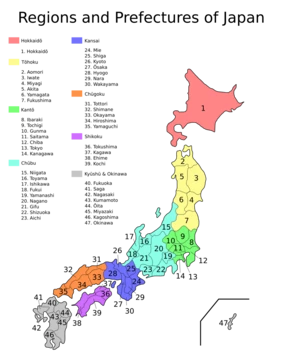
Akita Prefecture
A northern Japanese prefecture with rich traditions and declining population.

via Wikipedia: Akita Prefecture · see source
Akita Prefecture is a prefecture of Japan located in the Tōhoku region of Honshu, bordered by the Sea of Japan to the west and the Ōu Mountains to the east. It was formed almost entirely from the ancient province of Dewa, with only a small portion of its northern area (the Kazuno region) coming from Mutsu Province. It is known for its traditional industries, severe population decline, and cultural heritage including the Akita breed of dog and the Akita Bijin ('Beauties of Akita').
- Capital
- Akita
- Region
- Tōhoku, Honshu, Japan
- Known for
- Rice farming, sake breweries, Akita dog, Akita Bijin
Verified Timeline
Lore & Background
The region of Akita was created almost entirely from the ancient province of Dewa, with only the northern Kazuno area originating from Mutsu Province. In 1871, during the Meiji Restoration, Dewa Province was divided into modern Akita Prefecture and Yamagata Prefecture.
Reader's Guide
Akita Prefecture's significance lies in its role as a repository of traditional Japanese culture and its stark demographic challenges. Its economy remains dominated by agriculture, fishing, and forestry, leading many young people to migrate to larger cities. This depopulation has caused smaller communities to merge, and educational and health facilities have closed in some areas, perpetuating the decline. Culturally, Akita is famous for rice farming, sake breweries (with the highest sake consumption in Japan), the Akita breed of dog, and the Akita Bijin. The Heian period poet Ono no Komachi is said to have been born in the prefecture. Tourism efforts focus on green tourism and agritourism, drawing visitors to festivals like the Namahage ritual, Akita Kantō, and Omagari Fireworks, as well as preserved samurai houses in Kakunodate and hot springs near Lake Tazawa.
Did You Know?
- The Heian period waka poet Ono no Komachi is said to have been born in Yuzawa City, Ogachi Town, in the southeast of the prefecture.
- Akita Prefecture is thought to be the origin of the Akita breed of dog.
- The Namahage ritual in Oga on New Year's Eve draws a large number of tourists every year.
A Land Beyond the Mountains
Akita Prefecture's story begins in a kind of deliberate obscurity. For centuries the region sat behind the Ōu and Dewa mountain ranges, separated by hundreds of kilometres from Japan's commercial and political heartlands. Until roughly the year 600, the land was home to nomadic hunter-gatherer tribes with little recorded contact to the broader Japanese state. The first documented Japanese incursion came in 658, when Abe no Hirafu, governor of Koshi Province, defeated the native Ezo peoples near what are now the cities of Akita and Noshiro, then raised a fort along the Mogami River. A more permanent military settlement followed in 733, later becoming Akita Castle in the Takashimizu district, and the area served as a staging ground for imperial campaigns pushing Ezo communities further north. During the Tokugawa era, the Satake clan governed the territory for two and a half centuries, cultivating the agriculture and mining sectors that still anchor the local economy. It was not until the Meiji Restoration of 1871, when Dewa Province was reorganized and old daimyō domains dissolved, that the prefecture's modern borders took shape.
A Rectangle of Sea and Stone
Akita's geography reads almost like a geometric exercise: a roughly rectangular block measuring 169 kilometres north to south and 86 kilometres west to east, pressed against the Sea of Japan on its western face. The Oga Peninsula juts prominently from that western coastline, while the Ōu Mountains—Japan's longest continuous range—form the eastern boundary against Iwate Prefecture. Running parallel through the interior, the higher Dewa Mountains add a second ridge of elevation that shapes the prefecture's cold winters, especially in inland valleys far from maritime moderation. The land is not merely scenic; it is formally protected. As of 2019, eleven percent of the total area is set aside as Natural Parks, including Towada-Hachimantai National Park, the Chōkai, Kurikoma, and Oga Quasi-National Parks, and eight additional Prefectural Natural Parks stretching from Akita Shirakami to Tazawako Dakigaeri. Thirteen cities, along with numerous towns and villages, are distributed across this terrain, with Akita itself serving as the capital and largest urban centre, alongside Yokote, Daisen, and Yurihonjō.
The Long Emptying
Few places in modern Japan illustrate demographic contraction as starkly as Akita. The prefecture is one of only four in the country to have registered a continuous population decline since 1955, and by 2022 its estimated population had slipped to roughly 944,900. The age structure tells the steepest story: children under fifteen make up just 9.3 percent of residents, down from 11.2 percent in 2010, while 38.6 percent are sixty-five or older—the highest share of any Japanese prefecture. The root cause is economic. Akita's output remains anchored in agriculture, fishing, and forestry, industries that have struggled to retain young workers, many of whom relocate to Tokyo or other metropolitan centres for employment. As smaller communities shrink, they merge with neighbours, but the combined entities still face closures of local schools and clinics. Families then move to larger cities for better services, accelerating the very depopulation the mergers were meant to reverse. The result is a self-reinforcing cycle that rural communities across the prefecture are still trying to break.
Rice, Sake, and the Name Itself
The very name Akita—秋田—translates to "autumn rice paddy," a compact summary of the prefecture's cultural identity. Rice farming is central, and the local Akita komachi variety is a recognized specialty, as are dishes like Kiritanpo Nabe and Gakko. Sake production is equally emblematic; Akita is widely cited as the highest per-capita sake-consuming prefecture in Japan, and its breweries are a point of local pride. The Akita dog breed, which carries the prefecture's name, is thought to have originated here. The region also claims the legendary Heian-era waka poet Ono no Komachi as a native of Yuzawa City in its southeastern corner, and the broader concept of Akita Bijin—women celebrated for fair skin, rounded features, and high-pitched voices—has long been part of the area's cultural mythology. In sport, the prefecture fields teams across basketball, rugby, and football, including the Akita Northern Bullets and Blaublitz Akita. More recently, tourism initiatives have promoted green travel, agritourism, home stays, and the Oga New Year's Namahage ritual to draw urban and international visitors into these rural communities.
Gallery

More in Prefectures Of Japan 1-24
Related in Prefectures Of Japan
Links follow this subject's own source article.
Elsewhere in the Prefectures Of Japan universe
Spotted an error? Know more?
This is a living reference — every entry is fact-audited, and reader corrections feed straight into our audit queue. Suggest an edit · See this site's audit record