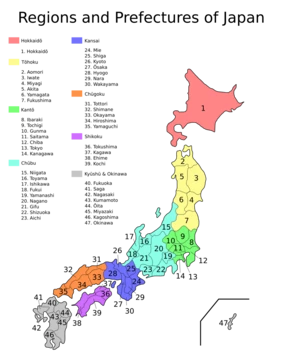
Aomori Prefecture
Northernmost prefecture on Honshu, home to Japan's oldest pottery.

via Wikipedia: Aomori Prefecture · see source
Aomori Prefecture is a prefecture of Japan located in the Tōhoku region, on the northernmost part of the main island of Honshu. It is notable for being the site of the oldest evidence of pottery in Japan, discovered at the Jōmon period Ōdai Yamamoto I Site, and for its distinctive subculture shaped by its remote location and long, snowy winters.
- known_for
- Oldest pottery in Japan, apple orchards, garlic production, Tsugaru-jamisen, Aomori Nebuta Matsuri
Lore & Background
The oldest evidence of pottery in Japan was found at the Ōdai Yamamoto I Site in the town of Sotogahama. During the Jōmon period, the Sannai-Maruyama Site in present-day Aomori city showed wide interaction with people from across Japan, including Hokkaido and Kyushu, before being abandoned around 2,300 BCE. The Jōmon period continued up to 300 BCE at the Kamegaoka site, where small statuettes called Shakōkidogū were found. After centuries of rule by the Nanbu and Tsugaru clans, the prefecture was formed from the northern part of Mutsu Province during the Meiji Restoration. The region experienced significant growth until the late 20th century, when a population decline began. The prefecture remains dominated by primary sector industries, especially apple orchards and garlic cultivation. It also serves as a transportation and logistics hub due to its location.
Reader's Guide
Aomori Prefecture holds significant historical and cultural importance in Japan. As the northernmost prefecture on Honshu, it has been a crossroads of trade and conflict, from the Jōmon period through the Nanbu and Andō clan rule. The discovery of the oldest pottery in Japan at the Ōdai Yamamoto I Site marks it as a key location for understanding early human habitation in the archipelago. The prefecture's subculture, influenced by its distance from central government and snowy winters, produced the traditional Tsugaru-jamisen and distinctive crafts such as embroidery, pottery, and lacquerware. Its economy, while rooted in agriculture and apple production, also benefits from tourism centered on the Jōmon Prehistoric Sites and Shirakami-Sanchi World Heritage Sites. The prefecture's religious beliefs, rooted in Shinto and Buddhism, include noted blind mediums and the purported tomb of Jesus. Aomori Prefecture's legacy is one of resilience and cultural distinctiveness within Japan.
Did You Know?
- The oldest evidence of pottery in Japan was discovered at the Ōdai Yamamoto I Site in Aomori Prefecture.
- Aomori Prefecture is famous for its high-quality garlic, though black garlic production leadership is not consistently attributed to it in official statistics.
- The prefecture is home to the purported tomb of Jesus.
Ancient Roots: The Jōmon Legacy
Aomori Prefecture carries one of the deepest archaeological records in all of Japan. Human presence here stretches back at least fifteen thousand years, and the prefecture's northwestern coast, specifically the Ōdai Yamamoto I Site in Sotogahama, yielded what scholars consider the oldest pottery evidence found anywhere in the country. By roughly seven thousand BCE, coastal communities had developed sophisticated fishing cultures along the shores. One of the most remarkable settlements of this era, Sannai-Maruyama, emerged around 3,900 BCE in what is now the city of Aomori. Archaeological findings there reveal extensive trade and cultural exchange reaching as far as Hokkaido and Kyushu, suggesting a far more interconnected Jōmon world than once assumed. The settlement eventually faded around 2,300 BCE, likely because its subsistence-based economy could not sustain growth amid a period of reduced natural resources linked to a neoglaciation. The Jōmon tradition persisted in the region until roughly 300 BCE, as evidenced by the small Shakōkidogū statuettes unearthed at the Kamegaoka site in Tsugaru. Today, these Jōmon Prehistoric Sites in Northern Japan hold World Heritage status, anchoring Aomori's identity in deep prehistory.
A Northern Edge: Geography & Natural Setting
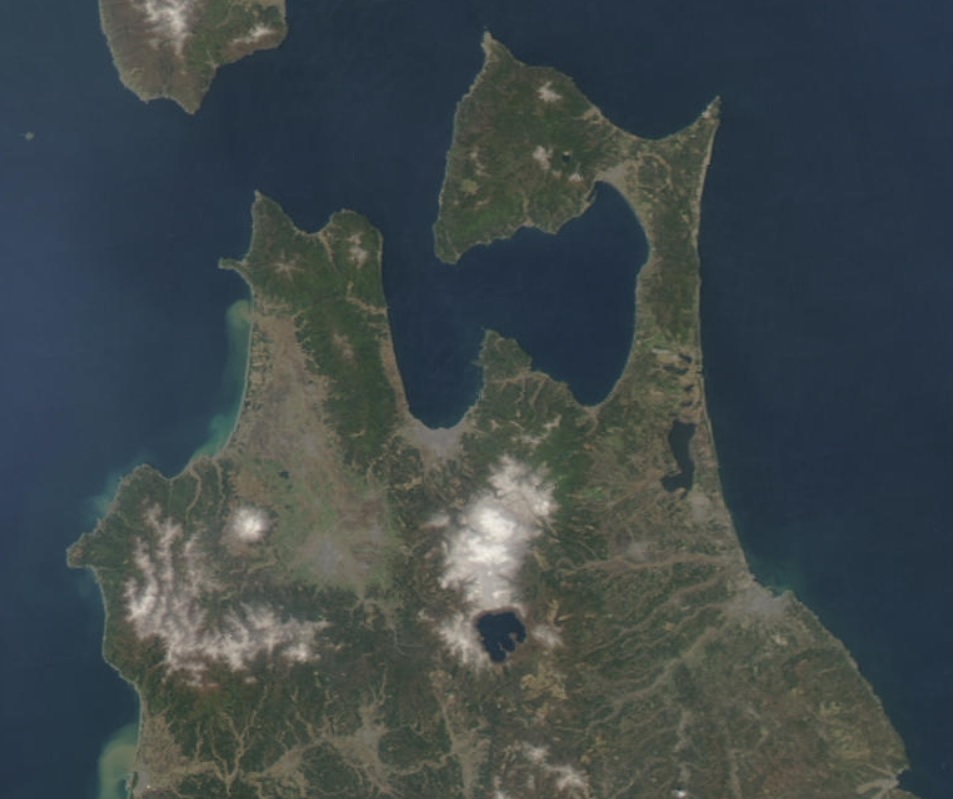
Sitting at the very top of Honshu, Aomori Prefecture occupies a singular geographic position. It is bordered by the Pacific Ocean to the east, the Sea of Japan to the west, Iwate to the southeast, Akita to the southwest, and across the Tsugaru Strait to the north lies Hokkaido. Spanning 9,645.64 square kilometers, it ranks as the eighth-largest prefecture in Japan, yet its population of just over 1.18 million places it thirty-first in density. The landscape is dominated by rugged terrain, with Mount Iwaki—an active stratovolcano—rising to 1,624.7 meters as the prefecture's highest point. Volcanic activity has shaped the region for millennia; historic records describe a series of devastating eruptions from the volcano at Lake Towada in 917, with the most intense activity peaking on August 17 of that year. The prefecture's position between two major seas and its strait connection to Hokkaido have long made it a natural crossroads. This strategic location underpins its modern role as a transportation and logistics hub, even as the broader Tōhoku region experienced significant population decline from the late twentieth century onward.
Craft, Rhythm & Ritual: A Distinctive Subculture
Aomori's identity is shaped in part by its relative remoteness from Japan's central government and by the long, heavy winters that define its climate. This isolation has fostered a rich subculture with its own musical, culinary, and artisanal traditions. The prefecture is the birthplace of the Tsugaru-jamisen, a local variant of the three-stringed shamisen that carries a distinctive playing style. Crafts such as embroidery, pottery, lacquerware, cabinetry, and iron working remain deeply rooted in local practice. On the culinary side, various porridges and soups are signature dishes, and Aomori stands out as Japan's largest producer of black garlic. The annual Aomori Nebuta Matsuri is the region's most celebrated festival, drawing visitors from across the country. Religious life is heavily grounded in Shinto and Buddhism, and the prefecture is noted for its tradition of blind mediums as well as a purported tomb of Jesus. Apple orchards dominate the agricultural landscape, while tourism—bolstered by World Heritage Sites including Shirakami-Sanchi—provides a vital economic pillar alongside the primary sector.
From Emishi to Prefecture: A Long Governance Story
The land now known as Aomori has passed through many hands across the centuries. During the Yayoi and Heian periods, the region—then called Michinoku—was home to the Emishi, whose northernmost tribe bore the name Tsugaru. The Imperial Court in Kyoto gradually subdued these communities, and by around 1094 the Northern Fujiwara had incorporated the area into Mutsu Province, ruling the Tōhoku region until their deposition by Minamoto no Yoritomo in 1189. The Nanbu clan, founded by Nanbu Mitsuyuki after his service at the Battle of Ishibashiyama, built power in the eastern part of the prefecture around horse ranches and the supply of warhorses. The Tsugaru clan also held sway for centuries. The modern prefecture was carved out of the northern portion of Mutsu Province during the Meiji Restoration of the nineteenth century. The name Aomori, meaning "blue forest" or "green forest," was first applied in 1624 to a port settlement established by the Hirosaki Domain, likely referencing a small woodland on a nearby hill that fishermen used as a navigational landmark.
Gallery

More in Prefectures Of Japan 1-24
Related in Prefectures Of Japan
Links follow this subject's own source article.
Elsewhere in the Prefectures Of Japan universe
Spotted an error? Know more?
This is a living reference — every entry is fact-audited, and reader corrections feed straight into our audit queue. Suggest an edit · See this site's audit record