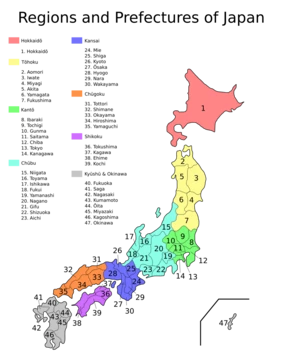
Osaka Prefecture
Second-most densely populated prefecture in Japan.

Wikipedia / Wikimedia Commons
Osaka Prefecture (Ōsaka-fu) is a prefecture of Japan located in the Kansai region of Honshu. It is one of Japan's two 'urban prefectures' using the designation fu, along with Kyoto Prefecture, and forms the center of the Keihanshin metropolitan area, the second-most-populated urban region in Japan after the Greater Tokyo area. Osaka is the capital and largest city, and the prefecture is the third-most-populous in Japan, though by geographic area it is the second-smallest, making it the second-most densely populated prefecture after Tokyo.
- population
- 8,778,035 (as of 1 April 2022)
- area
- 1,905 square kilometres (736 sq mi)
- capital
- Osaka
- region
- Kansai, Honshu
- density
- 4,600 inhabitants per square kilometre (12,000/sq mi)
Verified Timeline
Lore & Background
Osaka Prefecture was created on June 21, 1868, at the very beginning of the Meiji era. Prior to the Meiji Restoration, the area was split between Kawachi, Izumi, and Settsu provinces. During the instigation of Fuhanken Sanchisei in 1868, the prefecture received its suffix fu. On September 1, 1956, the city of Osaka was promoted to a city designated by government ordinance and divided into 24 wards. Sakai became the second such city on April 1, 2006, divided into seven wards. In 2000, Fusae Ota became Japan's first female governor, replacing Knock Yokoyama after his resignation due to prosecution for sexual harassment. Tōru Hashimoto, previously a television counselor, was elected governor in 2008 at age 38, becoming the youngest governor in Japan. On June 18, 2018, an earthquake struck the northern region, killing 4 people and causing minor damage across Greater Osaka.
Reader's Guide
Osaka Prefecture is significant as a major economic and demographic center of Japan. Its gross prefecture product for fiscal year 2004 was ¥38.7 trillion, second only to Tokyo, and it hosts globally renowned electronics giants such as Panasonic and Sharp. The prefecture has a high proportion of small and medium enterprises (SMEs), which accounted for 99.6% of all businesses in 2006 and produced 65.4% of the prefecture's manufactured output. The Osaka Securities Exchange, specializing in derivatives like Nikkei 225 Futures, is based here. Demographically, as of 2022, Osaka has about 93,000 ethnic Korean persons, the largest such population of any prefecture in Japan, a legacy of migration during the Japanese rule of Korea and World War II. Politically, the prefecture saw a proposed reorganization into an 'Osaka Metropolis' backed by Governor Tōru Hashimoto, but referendums in 2015 and 2020 both rejected the plan. Culturally, it is home to notable temples such as Shitennō-ji, Kanshin-ji, and Sumiyoshi Taisha, as well as museums including the National Museum of Ethnology and the Expo Commemoration Park, site of Expo '70.
Did You Know?
- Osaka Prefecture is one of only two prefectures in Japan using the designation 'fu' instead of 'ken', the other being Kyoto Prefecture.
- Fusae Ota became Japan's first female governor when she replaced Knock Yokoyama in 2000 after his resignation due to prosecution for sexual harassment.
- Tōru Hashimoto was elected governor in 2008 at age 38, becoming the youngest governor in Japan.
- As of 2022, Osaka Prefecture has about 93,000 ethnic Korean persons, the largest such population of any prefecture in Japan.
- A 2015 referendum on reorganizing Osaka Prefecture into an 'Osaka Metropolis' was defeated with 50.38% of voters opposed; a second referendum in 2020 was rejected by 50.6% of voters.
Geography & Density
Osaka Prefecture occupies a compact stretch of Japan's western coast on the Kii Peninsula, opening onto Osaka Bay. At just 1,905 square kilometres, it ranks as the second-smallest prefecture in the country — a distinction it nearly held before the construction of Kansai International Airport on an artificial island, which added enough land to nudge it past Kagawa Prefecture. Despite its modest footprint, the prefecture packs in roughly 8.78 million residents (as of April 2022), yielding a density of about 4,600 people per square kilometre. That makes it the second-most densely populated prefecture in Japan, trailing only Tokyo. The Yodo and Yamato Rivers thread through the landscape, while eleven percent of the total land area is set aside as natural parks, including the Kongō-Ikoma-Kisen and Meiji no Mori Minō Quasi-National Parks. To the northwest it touches Hyōgo, to the northeast Kyoto, to the southeast Nara, and to the south Wakayama, placing it at the crossroads of several major regional corridors.
Economy & Industry
The Keihanshin metropolitan area, centered on Osaka Prefecture, stands as the second-most-populated urban region in Japan and one of the world's most productive zones by GDP. In fiscal year 2004 alone, the prefecture's gross product reached ¥38.7 trillion — second only to Tokyo — representing roughly 48 percent of the entire Kinki region's output, with commercial sales hitting ¥60.1 trillion. While globally recognized electronics firms like Panasonic and Sharp anchor the industrial landscape, the true economic engine is the small and medium enterprise sector. In 2006, over 330,000 SMEs accounted for 99.6 percent of all businesses in the prefecture, and their manufactured output represented a striking 65.4 percent of total production — far above Tokyo's 55.5 percent or Kanagawa's 38.4 percent. The Osaka Securities Exchange, home to derivatives markets including Nikkei 225 Futures, adds a financial dimension. A notable example of industry-education collaboration is Astro-Technology SOHLA, an artificial satellite project that began among Higashiosaka-based SMEs and later earned backing from JAXA and NEDO.
Political History & Governance
Osaka Prefecture was formally established on June 21, 1868, at the dawn of the Meiji era, when the old provinces of Kawachi, Izumi, and Settsu were consolidated. It received the distinctive 'fu' suffix through the Fuhanken Sanchisei reorganization, a designation it shares with only Kyoto Prefecture, marking both as 'urban prefectures' in contrast to the standard 'ken' used elsewhere. The prefecture's political history has produced landmark firsts: in 2000, Fusae Ota became Japan's first female governor, succeeding Knock Yokoyama who resigned amid a sexual harassment prosecution. In 2008, television personality Tōru Hashimoto won the governorship at just 38, the youngest in the nation. Hashimoto went on to champion the Osaka Restoration Association in 2010, seeking to merge the prefecture with Osaka City into a single 'Osaka Metropolis.' The plan swept the 2011 local elections, but voters ultimately rejected the reorganization in a 2015 referendum (50.38 percent opposed) and again in 2020 (50.6 percent against).
Municipal Evolution & Consolidation
The administrative map of Osaka Prefecture is the product of more than a century of consolidation. When modern districts were reactivated in 1878–79, the territory (including Sakai, which had only been merged into Osaka in 1881) comprised five urban districts and 27 rural districts. The 1889 municipal subdivision transformed the urban districts into two independent cities — Osaka and Sakai — while the rural districts fractured into 12 towns and 310 villages. Osaka City's aggressive absorption of neighboring municipalities during the Taishō era had already cut the total to 149 by 1953. The Great Shōwa mergers of the 1950s then slashed the count to 47 by 1961, with 26 of those already holding city status. The final round, the Great Heisei mergers, brought the number to the current 43 municipalities — 33 cities, nine towns, and one village — by 2005. Within that structure, Osaka City was elevated to a designated city in 1956 and split into 24 wards, while Sakai received the same designation in 2006 with seven wards.
Gallery




Frequently Asked Questions
Who is Osaka Prefecture?
Osaka Prefecture is a densely packed urban prefecture in the Kansai region of Honshu, Japan, and one of only two Japanese prefectures that carry the 'fu' designation alongside Kyoto. It anchors the Keihanshin metropolitan area and is home to roughly 8.78 million residents.
What are Osaka Prefecture's powers/role?
As Japan's second-most densely populated prefecture, Osaka acts as the economic and cultural engine of the Kansai region, driving trade, industry, and commerce across western Honshu. Its compact 1,905 km² footprint holding over 4,600 people per square kilometre gives it influence far beyond its small geographic size.
How does Osaka Prefecture's story end?
As a living administrative entity rather than a finite narrative, Osaka Prefecture has no canonical ending; its ongoing arc continues as the beating heart of Japan's second-largest metropolitan cluster. Fans of the region often point to its evolving urban development and cultural renaissance as the current chapter of its story.
Why is Osaka Prefecture important?
Osaka is the third-most populous prefecture in Japan and the central node of the Keihanshin area, which ranks as the country's second-largest urban region after Greater Tokyo. Its long-standing role as a commercial hub makes it indispensable to understanding Japan's broader economic and cultural landscape.
Where does Osaka Prefecture sit in the broader map?
Osaka Prefecture occupies a compact stretch in the southern Kansai region of Honshu, with the Seto Inland Sea bordering it to the west. Its position places it at the crossroads of major routes linking Kyoto to the north, Nara to the east, and Hyōgo to the west.
More in Prefectures Of Japan 25-39
Related in Prefectures Of Japan
Links follow this subject's own source article.
Elsewhere in the Prefectures Of Japan universe
Spotted an error? Know more?
This is a living reference — every entry is fact-audited, and reader corrections feed straight into our audit queue. Suggest an edit · See this site's audit record