Shimane Prefecture
Second-least populous prefecture, home to ancient Izumo-taisha shrine.

Wikipedia / Wikimedia Commons
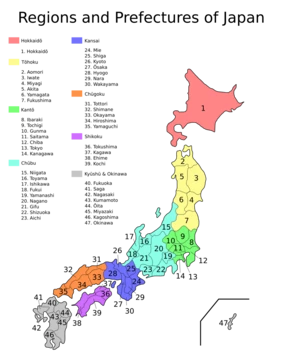
Shimane Prefecture is a prefecture of Japan located in the Chūgoku region of Honshu. It is the second-least populous prefecture of Japan, with a population of 665,205 as of February 1, 2021, and a geographic area of 6,708.26 km². The capital and largest city is Matsue, and the prefecture is home to Izumo-taisha, one of the oldest Shinto shrines in Japan, and the Tokugawa-era Matsue Castle.
- Capital
- Matsue
- Population
- 665,205 (February 1, 2021)
- Area
- 6,708.26 km²
- Region
- Chūgoku region of Honshu
- Major Cities
- Matsue, Izumo, Hamada, Masuda
- Notable Sites
- Izumo-taisha, Matsue Castle, Iwami Ginzan Silver Mine (UNESCO World Heritage Sit
Lore & Background
Shimane Prefecture's history starts with Japanese mythology. The Shinto god Ōkuninushi was believed to live in Izumo, an old province in Shimane. Izumo Shrine, in the city of Izumo, honors the god. During the Nara period, Kakinomoto no Hitomaro wrote a poem on Shimane's nature when he was sent as the Royal governor. Later, in the Kamakura period (1185–1333), the Kamakura shogunate forced emperors Go-Toba and Godaigo into exile in Oki. Emperor Go-Daigo later escaped from Oki and began rallying supporters against the shogunate, which proved successful. In the Muromachi period (1336–1573), the Amago clan expanded power based in Gassantoda Castle and the Masuda clan dominated Iwami Province. The Iwami Ginzan Silver Mine was located between their territories, and there were many battles between the clans for the silver. In 1566 Mōri Motonari conquered Izumo, Iwami, and Oki. In 1600, after over 30 years of Mori control, Horio Yoshiharu entered Izumo and Oki as the result of the Battle of Sekigahara. Horio Yoshiharu decided to build Matsue Castle instead of Gassan-Toda, and soon after his death the castle was completed. In 1638, the grandson of Tokugawa Ieyasu, Matsudaira Naomasa, became the ruler because the Horio clan had no heir, and his family ruled until the abolition of the han system.
Reader's Guide
Shimane Prefecture is situated on the Sea of Japan side of the Chūgoku region. Because of its mountainous landscape, rice farming is done mostly in the Izumo plain. The Shimane peninsula created two brackish lakes, Lake Shinji and Nakaumi. Off the main island of Honshū, the island of Oki belongs to Shimane prefecture and is in the Daisen-Oki National Park. Shimane also claims the use of Liancourt Rocks (Takeshima), over which they are in dispute with South Korea. Most major cities are located either on the seaside or along a river. The prefecture has a sub-tropical climate, with an average annual temperature of 14.6 °C and average annual precipitation of 1,799 millimetres. For transportation, three airports serve Shimane: Izumo Airport, Iwami Airport, and Oki Airport. JR West and Ichibata Electric Railway serve the prefecture by rail, with the Sanin Main Line going through major cities such as Matsue and Izumo. The overnight limited express Sunrise Izumo operates daily between Tokyo and Izumoshi. In the economy, the largest employer is the retail industry, employing over 60,000 workers, followed by manufacturing with 49,000 workers. Companies based in Shimane include Izumo Murata Manufacturing, Mitsubishi Agricultural Machinery, and Shimane Fujitsu. Demographically, one-third of the prefecture's population is concentrated in the Izumo-Matsue area, and the capital Matsue has the smallest population of all 47 prefectural capitals. Shimane has the largest percentage of elderly people in Japan, and had an estimated 743 centenarians per million inhabitants in September 2010, the highest ratio in Japan.
Did You Know?
- Shimane Prefecture is the second-least populous prefecture of Japan, with a population of 665,205 as of February 1, 2021.
- The capital, Matsue, has the smallest population of all 47 prefectural capitals.
- Shimane had an estimated 743 centenarians per million inhabitants in September 2010, the highest ratio in Japan.
- The overnight limited express Sunrise Izumo operates daily between Tokyo and Izumoshi.
- The Iwami Ginzan Silver Mine was one of Japan's largest silver mines by the early 17th century and is now a UNESCO World Heritage Site.
More in Prefectures Of Japan 25-39
Related in Prefectures Of Japan
Links follow this subject's own source article.
Elsewhere in the Prefectures Of Japan universe
Spotted an error? Know more?
This is a living reference — every entry is fact-audited, and reader corrections feed straight into our audit queue. Suggest an edit · See this site's audit record