Mie Prefecture
Prefecture on Honshu with ancient Shinto shrines and modern industry.

via Wikipedia: Mie Prefecture · see source
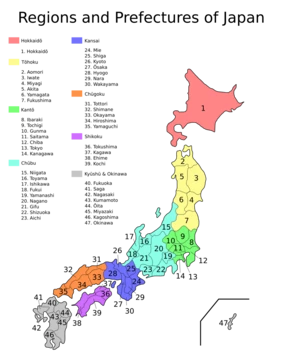
Mie Prefecture (三重県, Mie-ken) is a prefecture of Japan located in the Kansai region of Honshu. It has a population of 1,781,948 as of 1 June 2019 and a geographic area of 5,774 square kilometers (2,229 sq mi). Mie is bordered by Gifu Prefecture to the north, Shiga Prefecture and Kyoto Prefecture to the northwest, Nara Prefecture to the west, Wakayama Prefecture to the southwest, and Aichi Prefecture to the east. Tsu is the capital and Yokkaichi is the largest city. The prefecture sits on the eastern coast of the Kii Peninsula, forming the western side of Ise Bay, which features the mouths of the Kiso Three Rivers. Mie is a popular tourism destination home to Nagashima Spa Land, the Suzuka International Racing Course, and some of the oldest and holiest sites in Shinto, including the Ise Grand Shrine and the Tsubaki Grand Shrine.
- Capital
- Tsu
- Largest City
- Yokkaichi
- Population
- 1,781,948 (as of 1 June 2019)
- Area
- 5,774 km²
- Region
- Kansai region of Honshu
- Notable Sites
- Ise Grand Shrine, Tsubaki Grand Shrine, Suzuka International Racing Course
Verified Timeline
Lore & Background
Until the Meiji Restoration, the area now known as Mie Prefecture consisted of Ise Province, Shima Province, Iga Province, and part of Kii Province. Evidence of human habitation in Mie dates back more than 10,000 years. During the Jōmon and Yayoi periods, agricultural communities began to form along the river and coastal areas. Ise Shrine is said to have been established during the Yayoi period, and in the 7th century the Saikū Imperial Residence was built in what is now Meiwa Town to serve as both a residence and administrative centre for the Saiō, an Imperial Princess who served as High Priestess of Ise Shrine. During the Edo period, the area consisted of several feudal domains, each ruled by an appointed lord. Transport networks, including the Tokaido and Ise Roads, were built. Port towns such as Ohminato, Kuwana and Anōtsu, posting stations and castle towns flourished. Pilgrimages to Ise Shrine also became very popular. After the Meiji Restoration, the former provinces were reorganized repeatedly. In 1871, the area from the Kiso Three Rivers in the north to present-day Tsu became Anōtsu Prefecture, and the area south of that became Watarai Prefecture. In 1872, Anōtsu was renamed Mie, and in 1876, Mie Prefecture took its present-day form when it merged with its southern neighbor. The name Mie supposedly was taken from a comment about the region made by Yamato Takeru on his way back from conquering the eastern regions. In 1959, many people died as parts of Mie were devastated by the Ise-wan Typhoon, the strongest typhoon to hit Japan in recorded history. In May 2016, the city of Shima hosted the 42nd G7 summit.
Reader's Guide
Mie Prefecture has traditionally been a link between east and west Japan, thanks largely to the Tokaido and Ise Pilgrimage Roads. Traditional handicrafts such as Iga Braid, Yokkaichi Banko Pottery, Suzuka Ink, Iga Pottery and Ise Katagami flourished. With 65% of the prefecture consisting of forests and with over 1,000 km of coastline, Mie has long been associated with forestry and seafood industries. Mie also produces tea, beef, cultured pearls and fruit, mainly mandarin oranges. Northern Mie is home to a number of manufacturing industries, mainly transport machinery manufacturing (vehicles and ships) and heavy chemical industries such as oil refineries. Mie is also expanding into advanced industries including the manufacture of semiconductors and liquid crystal displays. In Suzuka, the Honda Motor Company maintains a factory established in 1960 that built the Honda Civic, as well as other vehicles. Notable places include the Ise Grand Shrine, Japan's holiest Shinto shrine; the Tsubaki Grand Shrine, Japan's oldest Shinto shrine; the Kumano Kodō World Heritage Site; Iga-Ueno, birthplace of the ninja; and the Suzuka Circuit, Japan's most famous motor racetrack. The Ise Plain has a relatively moderate climate averaging 14 to 15 °C for the year, while the Iga Basin averages 1 to 2 degrees cooler. Southern Mie has a warmer Pacific marine climate, with Owase Region having one of the heaviest rainfall figures for all of Japan.
Did You Know?
- The name Mie supposedly was taken from a comment about the region made by Yamato Takeru on his way back from conquering the eastern regions.
- In 1959, the Ise-wan Typhoon, the strongest typhoon to hit Japan in recorded history, devastated parts of Mie, causing many deaths.
- The Saikū Imperial Residence was built in the 7th century in what is now Meiwa Town for the Saiō, an Imperial Princess who served as High Priestess of Ise Shrine.
- Mie Prefecture took its present-day form in 1876 when it merged with its southern neighbor, Watarai Prefecture.
- The Owase Region in southern Mie has one of the heaviest rainfall figures for all of Japan.
More in Prefectures Of Japan 1-24
Related in Prefectures Of Japan
Links follow this subject's own source article.
Elsewhere in the Prefectures Of Japan universe
Spotted an error? Know more?
This is a living reference — every entry is fact-audited, and reader corrections feed straight into our audit queue. Suggest an edit · See this site's audit record