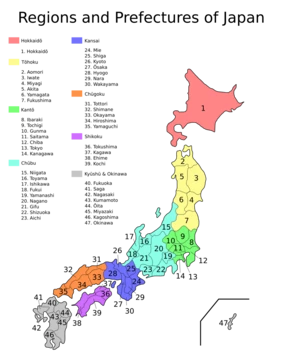
Ehime Prefecture
Prefecture on Shikoku, home to three Nobel laureates.

wongwt · CC BY-SA 2.0
Ehime Prefecture is a prefecture of Japan located on the island of Shikoku. Matsuyama is the capital and largest city, and the prefecture is known for its historical role as Iyo Province, its citrus fruit production, and for being the birthplace of three Nobel Prize winners.
- Capital
- Matsuyama
- Island
- Shikoku
Lore & Background
Until the Meiji Restoration, Ehime Prefecture was known as Iyo Province. Since before the Heian period, the area was dominated by fishermen and sailors who played an important role in defending Japan against pirates and Mongolian invasions. After the Battle of Sekigahara, the Tokugawa shōgun gave the area to his allies, including Katō Yoshiaki who built Matsuyama Castle, forming the basis for the modern city of Matsuyama. The name Ehime comes from the kuniumi part of the Kojiki where Iyo Province is mythologically named Ehime, 'lovely princess'. The prefecture includes both high mountains in the inland region and a long coastline, with many islands in the Seto Inland Sea. The westernmost arm of Ehime, the Sadamisaki Peninsula, is the narrowest peninsula in Japan. Dōgo Onsen, located in Matsuyama, is one of Japan's most famous hot springs and has been used for over two thousand years.
Reader's Guide
Ehime Prefecture holds significance as a historical and cultural hub on Shikoku. Its legacy includes the ancient Iyo Province, the construction of Matsuyama Castle, and the mythological origin of its name. The prefecture is notable for producing three Nobel Prize winners in literature and physics, reflecting its intellectual contributions. Economically, Ehime is known for shipbuilding, chemical industries, and citrus fruit cultivation, particularly mikan. Culturally, it features the ancient Dōgo Onsen hot spring, major festivals like the Niihama Taiko Festival, and is the setting for numerous films and novels, including Natsume Sōseki's 'Botchan'. Its Iyo dialect and natural parks further enrich its distinct identity.
Did You Know?
- Dōgo Onsen, located in Matsuyama, is one of Japan's most famous hot springs and has been used for over two thousand years.
- Three Nobel Prize winners are notable past residents: Kenzaburo Oe, Shuji Nakamura, and Syukuro Manabe.
- The name Ehime comes from the Kojiki, where Iyo Province is mythologically named Ehime, meaning 'lovely princess'.
From Iyo to Ehime: A Layered Past
Long before it bore its current name, the land now known as Ehime was called Iyo Province, a designation that persisted until the Meiji Restoration reshaped Japan's administrative map. The region's early identity was forged by its people: fishermen and sailors who, from before the Heian period onward, served as a vital maritime defense line, helping to repel both pirates and the Mongol fleets that threatened the Japanese archipelago. After the decisive Battle of Sekigahara, the Tokugawa shogun redistributed the territory among his loyal allies. Among them was Katō Yoshiaki, who raised Matsuyama Castle and thereby laid the foundations of what would become the prefecture's capital and largest city. The very name Ehime carries mythic weight, drawn from the Kojiki, where Iyo Province is poetically referred to as Ehime, meaning 'lovely princess.' More recently, in 2012, researchers from the University of Tokyo and Ehime University announced the discovery of rare earth mineral deposits in the Matsuyama area, hinting at the region's continued geological surprises.
A Land of Coasts, Peaks, and Islands
Tucked into the northwestern corner of Shikoku island, Ehime stretches across roughly 5,676 square kilometres and is home to just over 1.3 million residents. Its geography is strikingly varied: the interior rises into high mountain ranges, while the northern shore opens onto the calm waters of the Seto Inland Sea, dotted with numerous small islands. To the east, the prefecture shares borders with Kagawa and Tokushima; to the southeast lies Kōchi. In a curious geographic footnote, Ehime also shares a 74-metre boundary with Hiroshima Prefecture on the tiny island of Hyōtanjima, making it one of Japan's most unusual prefectural adjacencies. The westernmost tip, the Sadamisaki Peninsula, holds the distinction of being the narrowest peninsula in the entire country. Conservation efforts are substantial: as of March 2020, seven percent of the prefecture's total land area is protected within a network of national, quasi-national, and prefectural natural parks, including Ashizuri-Uwakai and Setonaikai National Parks and the Ishizuchi Quasi-National Park.
Living Traditions and Literary Roots
Ehime's cultural life is anchored by traditions that stretch back millennia. Dōgo Onsen, nestled in Matsuyama, is recognized as the oldest extant hot spring in Japan, with documented use spanning more than two thousand years and a mention in the ancient chronicle Nihon Shoki. Today it offers three public bathing areas: the main building, Tsubaki no Yu, and Asuka no Yu. The prefecture's festival calendar is equally vivid. The Uwajima Ushi-oni Festival fills three days with a parade of Ushi-oni figures, traditional Uwajima dancing, a fireworks display, and a closing running event. In Niihama, the autumn Taiko Festival sees roughly 150 men hoist a massive drum stand, making it one of Japan's three great fight festivals. Literary connections run deep: Natsume Sōseki set his novel Botchan in Matsuyama, and Ryōtarō Shiba's Saka no Ue no Kumo features characters from the prefecture. The local Iyo dialect itself carries regional diversity, with the Nanyo variety showing Kyushu influences and the Chuyo and Toyo varieties reflecting Kinki speech patterns.
Industry, Innovation, and Sporting Spirit
Along the coasts of Imabari and Saijō, heavy industry defines the economic landscape. Imabari Shipbuilding, Japan's largest shipbuilder, operates its dockyards here, alongside chemical plants, oil refineries, and factories producing paper and cotton textiles. In the countryside, the economy shifts toward agriculture and fishing, with citrus cultivation—particularly mikan and iyokan varieties—and cultured pearl farming standing out as signature products. Energy production also plays a major role: the Ikata Nuclear Power Plant generates a significant share of Shikoku Electric Power's output. Perhaps most remarkably, this prefecture of just over 1.3 million people has produced three Nobel laureates: Kenzaburo Oe (Literature, 1994), Shuji Nakamura (Physics, 2014), and Syukuro Manabe (Physics, 2021). Sporting culture thrives as well, with professional football clubs Ehime FC and FC Imabari, the Ehime Mandarin Pirates in baseball, and the Ehime Orange Vikings in basketball all calling the region home.
Gallery
More in Prefectures Of Japan 1-24
Elsewhere in the Prefectures Of Japan universe
Spotted an error? Know more?
This is a living reference — every entry is fact-audited, and reader corrections feed straight into our audit queue. Suggest an edit · See this site's audit record