Gifu Prefecture
Historic crossroads of Japan, home to Sengoku-era warlords.

via Wikipedia: Gifu Prefecture · see source
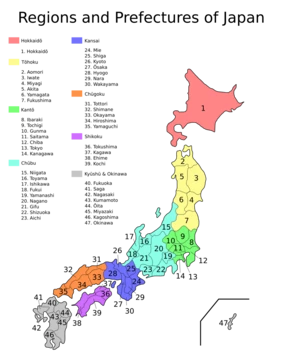
Gifu Prefecture is a prefecture of Japan located in the Chūbu region of Honshu. It has a population of 2,040,000 as of April 1, 2025, and a geographic area of 10,621 square kilometres (4,101 sq mi). Gifu is the capital and largest city. The prefecture borders Toyama, Ishikawa, Fukui, Shiga, Mie, Aichi, and Nagano prefectures. It is one of only eight inland prefectures and features the country's center of population. Gifu has served as the historic crossroads of Japan with routes connecting east to west, including the Nakasendō, one of the Five Routes of the Edo period. It was a long-term residence of Oda Nobunaga and Saitō Dōsan, spawning the phrase 'control Gifu and you control Japan' in the late Medieval era.
- Population
- 2,040,000 (as of April 1, 2025)
- Area
- 10,621 square kilometres (4,101 sq mi)
- Capital
- Gifu
- Region
- Chūbu region, Honshu
- Known for
- Historic crossroads, cormorant fishing, swordsmithing, Washi paper
Lore & Background
The land area that makes up modern-day Gifu became part of the Yamato Court around the middle of the fourth century. Because it is in the middle of Honshu, it has been the site of many decisive battles, the oldest major one being the Jinshin War in 672, which led to the establishment of Emperor Tenmu as the 40th emperor of Japan. The area consists of the old provinces of Hida and Mino, as well as smaller parts of Echizen and Shinano. The name of the prefecture derives from its capital city, Gifu, which was named by Oda Nobunaga during his campaign to unify all of Japan in 1567. The first character comes from Qishan, a legendary mountain from which most of China was unified, and the second from Qufu, the birthplace of Confucius. Nobunaga chose those characters because he wanted to unify all of Japan and be viewed as a great mind. Historically, the prefecture served as the center of swordmaking for all of Japan, with Seki known for making the best swords. The Mino region has long been known for its high-quality paper called Mino washi, which is stronger and thinner than most other papers in Japan and was used by the Japanese military during World War II. Other traditional goods include Gifu lanterns, Gifu umbrellas, mino-yaki pottery in Tajimi, Toki, and Mizunami, cutlery in Seki, and lacquerware in Takayama. The prefecture is also home to the 1,300-year-old tradition of cormorant fishing on the Nagara River.
Reader's Guide
Gifu Prefecture's significance lies in its central location and historical role as a crossroads of Japan, influencing military and political unification during the Sengoku period. The phrase 'control Gifu and you control Japan' reflects its strategic importance. Its legacy includes traditional industries such as swordsmithing, paper-making, and cormorant fishing, which continue to define its cultural identity. Modern industries like aerospace engineering in Kakamigahara and information technology in Ōgaki and Kakamigahara have diversified its economy. The prefecture also contains the site of the Battle of Sekigahara and the UNESCO World Heritage Site of Shirakawa's historic villages. Its varied geography, from the mountainous Hida region to the fertile Nōbi Plain, supports both agriculture and tourism, including hot springs in Gero and the preserved town of Takayama, often called Little Kyoto. The Kamioka area of Hida is home to the Kamioka Observatory underground laboratory, 1,000 m underground, housing the Super-Kamiokande experiment and the KamLAND experiment.
Did You Know?
- On August 16, 2007, Tajimi set the record for the hottest day in Japan's history at 40.9 °C (105.6 °F).
- The center of Japanese population is located in Seki City, Gifu Prefecture, based on the 2005 census.
- The Mino–Owari earthquake on October 28, 1891, was the second largest earthquake to ever hit Japan, estimated at 8.0 surface-wave magnitude.
- Shōkawa-chō, part of Takayama, is called the coldest inhabited place on Honshū.
- The Super-Kamiokande experiment in Hida uses a tank 41.4 m tall and 39.3 m in diameter holding 50,000 tons of ultra-pure water.
More in Prefectures Of Japan 1-24
Related in Prefectures Of Japan
Links follow this subject's own source article.
Elsewhere in the Prefectures Of Japan universe
Spotted an error? Know more?
This is a living reference — every entry is fact-audited, and reader corrections feed straight into our audit queue. Suggest an edit · See this site's audit record