Iwate Prefecture
Second-largest Japanese prefecture, with rich history and natural beauty.

via Wikipedia: Iwate Prefecture · see source
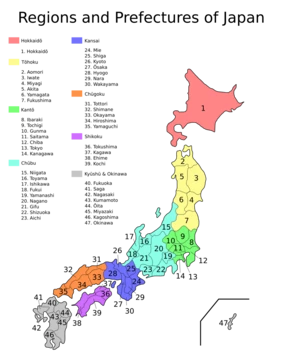
Iwate Prefecture is a prefecture of Japan located in the Tōhoku region of Honshu. It is the second-largest Japanese prefecture (behind Hokkaido) at 15,275 square kilometres (5,898 sq mi), with a population of 1,165,886 (as of July 1, 2023). Its capital and largest city is Morioka. Iwate Prefecture borders Aomori Prefecture to the north, Akita Prefecture to the west, and Miyagi Prefecture to the south. Located on Japan's Pacific Ocean coast, it features the easternmost point of Honshu at Cape Todo and shares the highest peaks of the Ōu Mountains. Iwate has the lowest population density of any prefecture outside Hokkaido, with 5% of its total land area designated as national parks.
- Area
- 15,275 square kilometres (5,898 sq mi)
- Population
- 1,165,886 (as of July 1, 2023)
- Capital
- Morioka
- Region
- Tōhoku region of Honshu
Verified Timeline
Lore & Background
The name 'Iwate' is linked to the legend Oni no tegata, associated with the Mitsuishi or 'Three Rocks' Shrine in Morioka. According to the tale, a devil who tormented locals was shackled to these rocks and forced to promise never to trouble them again, leaving a handprint on one rock—hence 'Iwate,' meaning 'rock hand.' Even after rainfall, it is said that the devil's hand print can still be seen there. Historically, the area was inhabited by the Jōmon people, leaving artifacts such as burial pits from the Middle Jōmon Period (2,800–1,900 BC) found in Nishida, and clay figurines, masks, and ear and nose shaped clay artifacts from the Late Jōmon Period (1,900–1,300 BC) at sites including Tateishi, Makumae and Hatten. The Yamato government claimed the island but could not occupy Iwate until 802, when Emishi leaders Aterui and More surrendered at Fort Isawa. The region later became part of Mutsu Province until the Meiji Restoration, and Iwate Prefecture was created in 1876. Culturally, Iwate is known for foods like walnuts, wanko soba (meaning 'bowl noodles'), and hittsumi-jiru (meaning 'pull and tear'). Poet Matsuo Bashō visited Hiraizumi and wrote about it in Oku no Hosomichi. The prefecture also features active volcanoes like Mt. Iwate (at 2,038 metres the highest point in the prefecture) and the Kitakami River, the fourth longest river in Japan and the longest in Tōhoku.
Reader's Guide
Iwate Prefecture holds significance as the second-largest prefecture in Japan, with a low population density and extensive natural parks covering 5% of its land. Its history reflects the long struggle between the Yamato government and the Emishi people, culminating in the surrender of leaders Aterui and More on 15 April 802 with some 500 warriors. The prefecture's cultural heritage includes the Buddhist temples of Hiraizumi, such as Chūson-ji and Mōtsū-ji, the Fujiwara no Sato movie lot and theme park in Ōshū, and the Tenshochi park in Kitakami known for its huge, ancient cherry trees. Economically, Iwate's industry is concentrated around Morioka and specializes in semiconductor and communications manufacturing. As of March 2011, the prefecture produced 3.9% of Japan's beef and 14.4% of broiler chickens. In 2009, 866 tons of dolphins and whales were harvested off the coast of Iwate, accounting for more than half of Japan's total catch of 1,404 tons. The prefecture's legacy is also tied to the poet Matsuo Bashō, who was especially inspired by the town of Hiraizumi. Its rugged coastline, mountain ranges, and hot springs continue to support tourism and local industry.
Did You Know?
- Iwate Prefecture features the easternmost point of Honshu at Cape Todo.
- The name 'Iwate' comes from a legend where a devil left a handprint on a rock, meaning 'rock hand'.
- The poet Matsuo Bashō visited Hiraizumi and wrote about it in his major work Oku no Hosomichi.
- As of March 2011, Iwate produced 3.9% of Japan's beef and 14.4% of broiler chickens.
- In 2009, Iwate accounted for more than half of Japan's total catch of dolphins and whales, harvesting 866 tons.
More in Prefectures Of Japan 1-24
Related in Prefectures Of Japan
Links follow this subject's own source article.
Elsewhere in the Prefectures Of Japan universe
Spotted an error? Know more?
This is a living reference — every entry is fact-audited, and reader corrections feed straight into our audit queue. Suggest an edit · See this site's audit record