Shimane Prefecture
Second-least populous prefecture, home to ancient Izumo-taisha shrine.
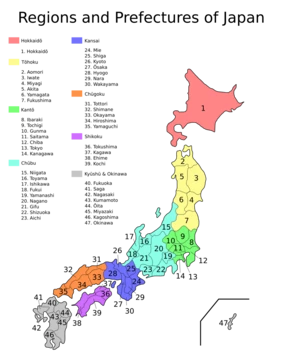
Shimane Prefecture sits in the Chūgoku region on the island of Honshu, Japan. With roughly 665,200 residents as of early 2021, it’s the country’s second-least populated prefecture, covering about 6,708 square kilometers. It borders Yamaguchi to the southwest, Hiroshima to the south, and Tottori to the east. The capital, Matsue, is also the largest city, followed by Izumo, Hamada, and Masuda. Most people live along the northern Sea of Japan coast, while the Chūgoku Mountains run through the south. The prefecture includes the Oki Islands out in the Sea of Japan and, juridically, the disputed Liancourt Rocks (called Takeshima in Japanese). Notable landmarks include Izumo-taisha, one of Japan’s oldest Shinto shrines, and Matsue Castle, which dates from the Tokugawa era.
Shimane’s early history is tied to Japanese mythology: the god Ōkuninushi was said to dwell in Izumo, an old province here, and Izumo Shrine honors him. Originally, the area was split into three provinces—Iwami, Izumo, and Oki—until the han system was abolished in 1871. During the Nara period, poet Kakinomoto no Hitomaro wrote about Shimane’s landscape while serving as a royal governor. In the Kamakura period (1185–1333), the shogunate exiled emperors Go-Toba and Go-Daigo to Oki; Go-Daigo later escaped and rallied supporters against the shogunate successfully.
In the Muromachi period (1336–1573), the Kyōgoku clan controlled Izumo and Oki, but after the Ōnin War, the Amago clan rose from Gassantoda Castle, and the Masuda clan dominated Iwami Province. The Iwami Ginzan Silver Mine, now a UNESCO World Heritage site, lay between their territories, sparking many battles. In 1566, Mōri Motonari conquered all three areas. After the Battle of Sekigahara in 1600, Horio Yoshiharu took over Izumo and Oki, choosing to build Matsue Castle instead of using Gassan-Toda; it was finished shortly after his death. In 1638, Tokugawa Ieyasu’s grandson became ruler when the Horio line died out, and his family governed until the han system ended. Iwami was split into three: the mining district under direct shogunate control, the Hamada clan region, and the Tsuwano clan region. The Hamada clan sided with the shogunate during the Meiji Restoration, and their castle was burned; the Tsuwano clan, ruled by the Matsudaira, backed the emperor.
In 1871, the han system’s abolition created Shimane and Hamada Provinces in the current area. Oki was added to Tottori that year. Hamada Prefecture merged into Shimane in 1876, and Tottori Prefecture was also added then. But in 1881, Tottori was separated, forming today’s borders.
Geographically, Shimane lies on the Sea of Japan side of the Chūgoku region. Its mountainous terrain limits rice farming mostly to the Izumo plain, where Izumo city sits. The Shimane peninsula stretches across the Sea of Japan from Izumo to Sakaiminato in Tottori, creating two brackish lakes: Lake Shinji and Nakaumi. Daikon Island lies in Nakaumi. Off Honshu, the Oki Islands belong to Shimane and are part of Daisen-Oki National Park. As of April 2012, 6% of the prefecture’s land was designated as natural parks, including Daisen-Oki National Park, Hiba-Dōgo-Taishaku and Nishi-Chūgoku Sanchi Quasi-National Parks, and eleven prefectural natural parks. Most major cities are coastal or along rivers.
Eight cities make up the prefecture, with Matsue the largest by population and Gōtsu the smallest. Masuda, Unnan, Yasugi, and Gōtsu saw slight population gains from early-2000s mergers. Towns and villages, though reduced in number by mergers, still hold about a third of the population.
The climate is subtropical: cloudy winters with some snow, humid summers. The rainy season, from June to mid-July, brings rain nearly every day. August is the hottest month. Annual precipitation is higher than Tokyo’s or Obihiro’s.
Three airports serve Shimane, with Izumo Airport in Izumo being the largest.
- Capital
- Matsue
- Population
- 665,205 (February 1, 2021)
- Area
- 6,708.26 km²
- Region
- Chūgoku region of Honshu
- Major Cities
- Matsue, Izumo, Hamada, Masuda
- Notable Sites
- Izumo-taisha, Matsue Castle, Iwami Ginzan Silver Mine (UNESCO World Heritage Sit
Lore & Background
Shimane Prefecture's history starts with Japanese mythology. The Shinto god Ōkuninushi was believed to live in Izumo, an old province in Shimane. Izumo Shrine, in the city of Izumo, honors the god. During the Nara period, Kakinomoto no Hitomaro wrote a poem on Shimane's nature when he was sent as the Royal governor. Later, in the Kamakura period (1185–1333), the Kamakura shogunate forced emperors Go-Toba and Godaigo into exile in Oki. Emperor Go-Daigo later escaped from Oki and began rallying supporters against the shogunate, which proved successful. In the Muromachi period (1336–1573), the Amago clan expanded power based in Gassantoda Castle and the Masuda clan dominated Iwami Province. The Iwami Ginzan Silver Mine was located between their territories, and there were many battles between the clans for the silver. In 1566 Mōri Motonari conquered Izumo, Iwami, and Oki. In 1600, after over 30 years of Mori control, Horio Yoshiharu entered Izumo and Oki as the result of the Battle of Sekigahara. Horio Yoshiharu decided to build Matsue Castle instead of Gassan-Toda, and soon after his death the castle was completed. In 1638, the grandson of Tokugawa Ieyasu, Matsudaira Naomasa, became the ruler because the Horio clan had no heir, and his family ruled until the abolition of the han system.
Reader's Guide
Shimane Prefecture is situated on the Sea of Japan side of the Chūgoku region. Because of its mountainous landscape, rice farming is done mostly in the Izumo plain. The Shimane peninsula created two brackish lakes, Lake Shinji and Nakaumi. Off the main island of Honshū, the island of Oki belongs to Shimane prefecture and is in the Daisen-Oki National Park. Shimane also claims the use of Liancourt Rocks (Takeshima), over which they are in dispute with South Korea. Most major cities are located either on the seaside or along a river. The prefecture has a sub-tropical climate, with an average annual temperature of 14.6 °C and average annual precipitation of 1,799 millimetres. For transportation, three airports serve Shimane: Izumo Airport, Iwami Airport, and Oki Airport. JR West and Ichibata Electric Railway serve the prefecture by rail, with the Sanin Main Line going through major cities such as Matsue and Izumo. The overnight limited express Sunrise Izumo operates daily between Tokyo and Izumoshi. In the economy, the largest employer is the retail industry, employing over 60,000 workers, followed by manufacturing with 49,000 workers. Companies based in Shimane include Izumo Murata Manufacturing, Mitsubishi Agricultural Machinery, and Shimane Fujitsu. Demographically, one-third of the prefecture's population is concentrated in the Izumo-Matsue area, and the capital Matsue has the smallest population of all 47 prefectural capitals. Shimane has the largest percentage of elderly people in Japan, and had an estimated 743 centenarians per million inhabitants in September 2010, the highest ratio in Japan.
Did You Know?
- Shimane Prefecture is the second-least populous prefecture of Japan, with a population of 665,205 as of February 1, 2021.
- The capital, Matsue, has the smallest population of all 47 prefectural capitals.
- Shimane had an estimated 743 centenarians per million inhabitants in September 2010, the highest ratio in Japan.
- The overnight limited express Sunrise Izumo operates daily between Tokyo and Izumoshi.
- The Iwami Ginzan Silver Mine was one of Japan's largest silver mines by the early 17th century and is now a UNESCO World Heritage Site.
More in Prefectures Of Japan 1-24
Related in Prefectures Of Japan
Links follow this subject's own source article.
Spotted an error? Know more?
This is a living reference — every entry is fact-audited, and reader corrections feed straight into our audit queue. Suggest an edit · See this site's audit record