Tokushima Prefecture
A Shikoku prefecture known for agriculture and the Ōnaruto Bridge.
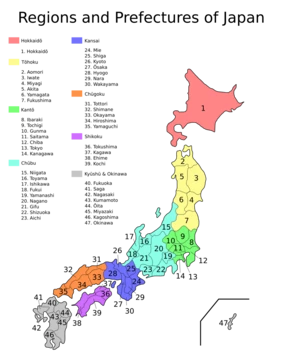
Tokushima Prefecture is a prefecture of Japan located on the island of Shikoku. The capital and largest city is Tokushima, with other major cities including Anan, Naruto, and Yoshinogawa. Historically known as Awa Province until the Meiji Restoration, the prefecture underwent several administrative consolidations before being inaugurated as Tokushima Prefecture on March 2, 1880. The prefecture borders Kagawa Prefecture to the north, Ehime Prefecture to the west, and Kōchi Prefecture to the southwest, and faces Wakayama Prefecture on Honshu across the Kii Channel, which connects the Pacific Ocean and the Seto Inland Sea. The Ōnaruto Bridge spans the Naruto Strait to Awaji Island, linking the prefecture via the Kobe-Awaji-Naruto Expressway to Kobe and the San'yō Expressway on Honshu.
In ancient times, the area of Tokushima City was known as Myōdō-gun. Following the abolition of the fiefdom system in 1871, it became Myodo Prefecture, which initially included the Awa region and Awaji Island, and later incorporated the area of modern Kagawa Prefecture in 1873. In a second consolidation, the Sanuki Region separated to form Kagawa Prefecture on September 5, 1875. On August 21, 1876, Awaji Island joined Hyōgo Prefecture, and the Awa region was merged into Kōchi Prefecture. Myodo Prefecture fully separated from Kōchi Prefecture to become Tokushima Prefecture on March 2, 1880.
Post-war events include the destruction of the Washi no Mon gate to Tokushima Castle by fire at the end of World War II in August 1945, and vast damage from the Nankai earthquake in December 1946. Naruto City was inaugurated in May 1947, and Tokushima University was created in May 1949. The Prefectural Library was completed in Tokushima Park in November 1953. The Nagayasuguchi Dam on the Naka River was completed in November 1957. A ferry from Komatsushima to Wakayama sank in January 1958 with no survivors. Anan City was inaugurated in May 1958. Shikoku Hoso began TV broadcasts in April 1959. A tsunami from a Chilean earthquake caused damage in the prefecture's south in May 1960. The Short Term Women's College in Tokushima opened in April 1961, later becoming Shikoku University. The Lesser Naruto Bridge opened in July 1961. The Tokushima Municipal Culture Center was completed in April 1963, and a new thermal electric power plant was created in Anan in July 1963. The Tokushima Airport terminal w
- capital
- Tokushima
- region
- Shikoku
- established
- March 2, 1880
- major_cities
- Anan, Naruto, Yoshinogawa
Lore & Background
Tokushima Prefecture occupies the eastern part of Shikoku, facing the Kii Channel which links the Pacific Ocean to the Seto Inland Sea. Its terrain covers approximately 4,146 square kilometers, and as of early 2025 its population stood at 682,439. The prefecture is bordered by Kagawa to the north, Ehime to the west, and Kōchi to the southwest. Across the Naruto Strait, the Ōnaruto Bridge connects Tokushima to Awaji Island and, via the Kobe-Awaji-Naruto Expressway, onward to Kobe and the San'yō Expressway on Honshu. The capital, Tokushima City, lies at the confluence of the Shinmachi and Suketō rivers, near the prefectural headquarters. Other major urban centers include Anan, Naruto, and Yoshinogawa. Historically, the area was known as Awa Province until the Meiji Restoration. After the abolition of the fiefdom system in 1871, it became Myodo Prefecture, which initially encompassed the Awa region and Awaji Island. Through successive consolidations, the Sanuki region separated to form Kagawa Prefecture in 1875, and Awaji Island joined Hyōgo Prefecture in 1876. The remaining Awa region was briefly merged into Kōchi Prefecture before fully separating on March 2, 1880, to be inaugurated as Tokushima Prefecture. Defining characteristics include its position as a gateway between Shikoku and Honshu, its river systems such as the Yoshino and Naka, and landmarks like the Ōnaruto Bridge and Tokushima Castle, whose Washi no Mon gate was lost to fire in 1945.
Reader's Guide
Tokushima Prefecture holds significance as a historical and administrative entity on Shikoku, connecting to Honshu via the Ōnaruto Bridge and the Akashi Kaikyo Bridge. Its economy depends on agriculture, forestry, and fisheries, being Japan's largest supplier of cauliflower and lotus roots and the fourth largest producer of carrots. Japanese indigo is produced only here.
Did You Know?
- Tokushima Prefecture was known as Awa Province until the Meiji Restoration.
- The Ōnaruto Bridge connects Tokushima to Awaji Island and Hyōgo Prefecture.
- Tokushima is Japan's largest supplier of cauliflower and lotus roots.
More in Prefectures Of Japan 1-24
Related in Prefectures Of Japan
Links follow this subject's own source article.
Spotted an error? Know more?
This is a living reference — every entry is fact-audited, and reader corrections feed straight into our audit queue. Suggest an edit · See this site's audit record